
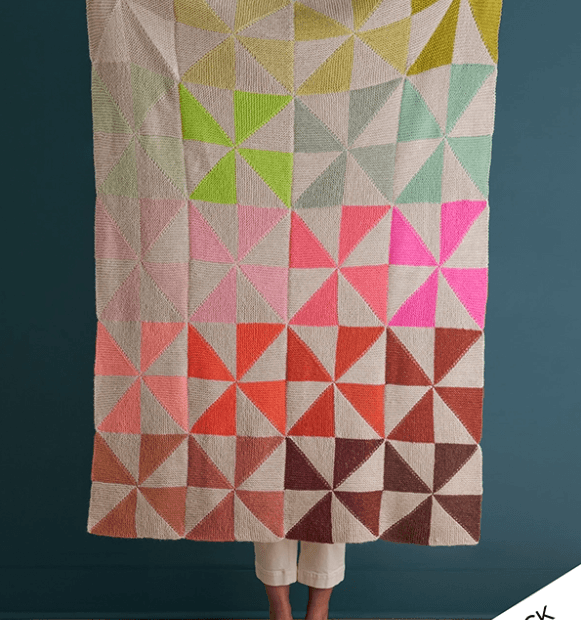
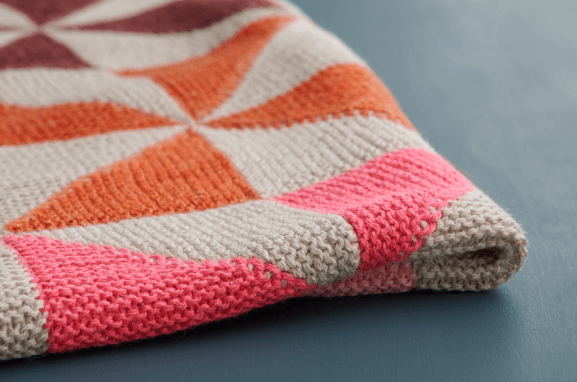
At first glance, this stunning afghan might have you convinced you’re looking at a quilt. The bold geometric blocks, the gradient wash of color moving across the piece, the crisp diagonal lines forming pinwheel shapes — it all reads like traditional patchwork from a distance. But look closer (as shown in the detail image below), and the truth reveals itself: every stitch of this piece is knitted, not sewn. That surprising contrast between its quilt-like appearance and its knitted construction is part of what makes this pattern so captivating.
A Design Built for Movement and Color
There’s a reason this pattern earns its name. Each block is constructed so that four triangular sections meet at a central point, creating the illusion of a pinwheel caught mid-spin. Multiply that motion across dozens of blocks, arranged in a deliberate gradient from warm tones to cool, and the whole blanket takes on a sense of rhythm and flow — as if a gentle breeze swept through and set every pinwheel twirling at once. Let this project be exactly that: a spark of creative momentum, built one colorful block at a time, with each pinwheel tumbling gracefully into place beside the last.
Meet the Designer
This pattern comes to us from Ksenia Naidyon, designed originally for Purl Soho. Naidyon is also the creative force behind Life Is Cozy, her own corner of the knitting world where she shares original patterns for hand-knit pieces, tutorials on essential stitch techniques, and honest reviews of needles, books, and notions — all the small but important details that knitters rely on to make informed choices about their craft. Her eye for color and geometry is on full display in this design, which balances precise construction with a playful, almost whimsical final result.
Finished Dimensions and What to Expect
Once complete, this afghan measures a generous 44 inches wide by 55 inches long, making it a substantial throw-sized blanket well-suited for a couch, an armchair, or draping across the end of a bed. Each individual pinwheel block finishes at 11 inches square, meaning the overall design comes together from a grid of these blocks joined together to form the finished piece. Working block by block also makes this a wonderfully portable project, since each square is a manageable, self-contained unit before being assembled into the larger whole.
A Word on Yarn Choices
While the original pattern recommends a specific yarn, this is a design that adapts beautifully to a variety of yarn choices. If you already have a stash of worsted or aran-weight yarn in colors you love, this pattern offers a wonderful opportunity to put it to use. The gradient effect seen in the sample photos works particularly well with a rainbow or ombre-inspired palette, but there’s plenty of room to make this pattern your own — whether that means sticking to a monochromatic scheme, choosing a bold contrast of just two or three colors, or going all out with as many shades as you can gather.
Why Block-Based Blanket Patterns Are Worth Trying
Blanket patterns built from individual blocks, like this one, offer several advantages over patterns knit in one continuous piece. For one, the modular nature of block-based construction makes the project far more portable and manageable, since you’re only ever working on one small square at a time rather than wrangling an enormous, heavy piece of fabric on your needles. It also makes color planning more approachable — you can decide on the fly how each block should transition into the next, adjusting your palette as you go rather than committing to an entire color scheme upfront.
Additionally, projects like this one are a fantastic way to practice new techniques in a low-commitment format. Each block becomes an opportunity to refine your consistency in colorwork, garter and stockinette transitions, and seaming, all while contributing to a much larger finished piece.
Getting Started
The complete, free instructions for this pattern are available directly through the link provided, offering everything you need to recreate this design from start to finish. Whether you’re drawn to it for the striking visual effect, the chance to work through your yarn stash creatively, or simply the satisfaction of watching each pinwheel block come together, this pattern offers a rewarding and visually impressive project for knitters ready for their next big undertaking.
A Few Tips Before You Cast On
If you’re new to intarsia or color-blocked knitting, it can help to keep a few bobbins or small yarn butterflies on hand for each color section within a block, preventing your yarn from tangling as you switch between shades. Blocking each square before assembly is also worth the extra time, as it helps square up any slight distortions in the knitting and makes seaming the finished blocks together much easier. Finally, laying out all your finished blocks in your desired arrangement before joining them permanently allows you to fine-tune your color gradient and ensure the overall effect reads exactly the way you envisioned it.
Here is a link to this free knitting pattern!
Image and Pattern Source: Purl Soho